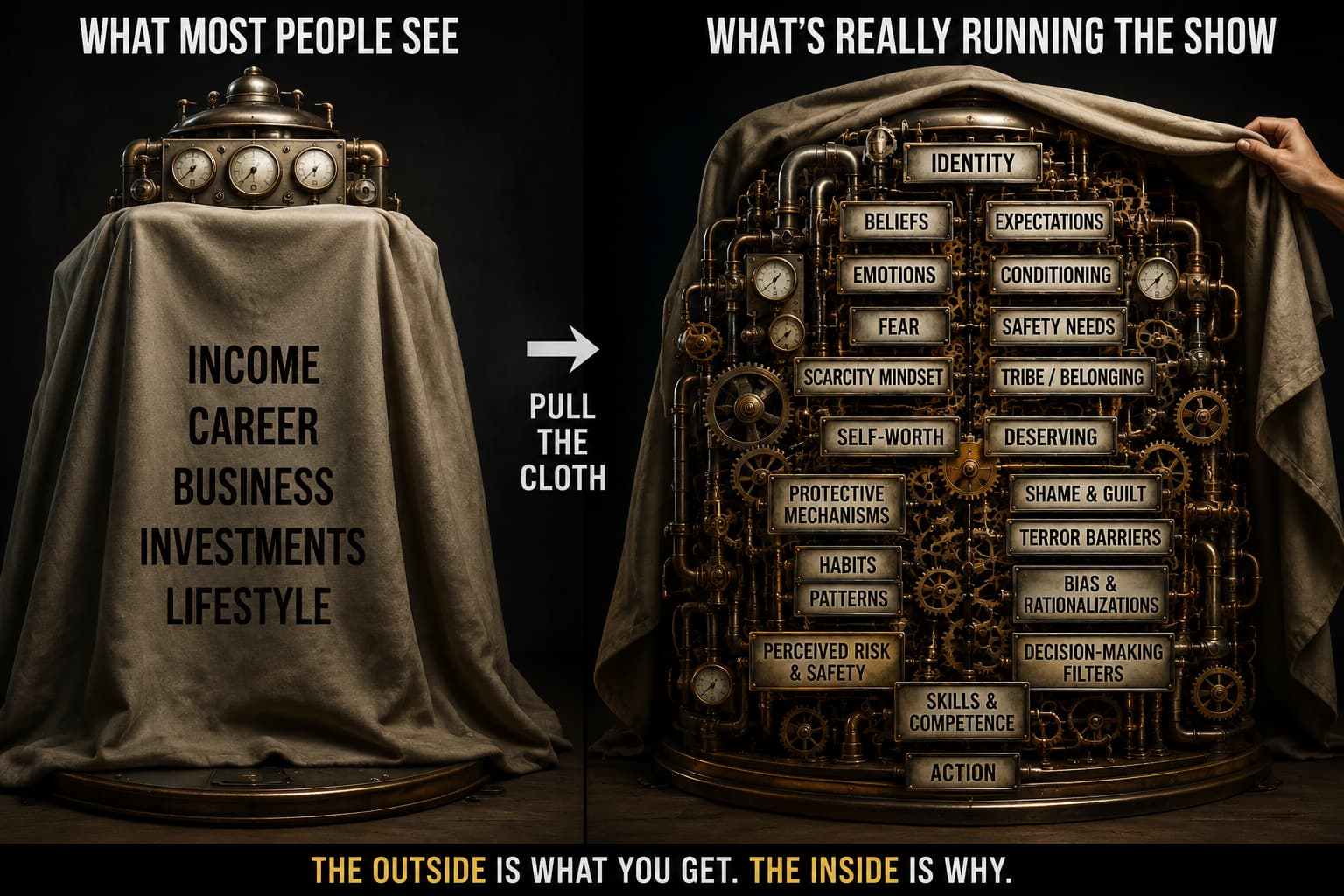
Exactly, the “inside me” is the identity, nervous system, subconscious conditioning, limiting beliefs, etc. And changing those things is a process that can be uncomfortable depending on multiple variables.
It applies to those things as well. I actually have essays on this offline, lol. There’s a self-help phenomenon I call “the double success standard”. So in a general wealth/financial/success context, a lot of people are familiar with the concept of identity, nervous system, subconscious conditioning, limiting beliefs, etc preventing progress. There are tons of content on this on YouTube for example. It’s quite mainstream within a certain level of self-help. Upper wealth limits, wealth thermostats, identity ceilings, nervous system safety, scarcity beliefs, self-sabotage protective mechanisms (homeostasis, tribe preservation, etc), emotional blocks (shame and guilt around wanting more for example), identity blocks (struggle identities, hard-worker identities for example), terror barriers, self-worth/deserve blocks, etc. The list goes on, it’s a whole curriculum that one could have a field day with. It’s everything behind the curtain running the show, that most people aren’t consciously aware of. It’s like an optical illusion where you see a machine’s head but its body is covered by a cloth, then you reveal the cloth and see all of the inner workings running the show.
This is pretty standard but this is where “the double success standard” kicks in.
I’ll go to a party, and talk to Joe about these types of things. Joe is in self-help, he knows this stuff backwards. And he applies a lot of it to his life. But when I ask “hey, how’s your dating life, are you seeing anybody?”. Joe is like “nah, I can’t find anyone that is my type, and all the attractive women out there seem to already have partners. And also, women cost a lot of time and money… it’s such a pain. I’m getting older now too, so it’s going to be harder for me to meet new people.”
And you can see the blind spot, lol.
The double standard is that people have been trained to think that the whole curriculum of deeper systems only applies to one area of life (wealth, career, business, etc). Joe will talk my ear off about nervous system regulation, scarcity programming, financial thermostats, self-worth, etc. He’ll wave all these shiny techniques, books, and courses in front of my face that can help with that type of work. But the moment we start talking about dating, romance, and relationships - all that shit goes out the window. The phenomenon is that because everyone in self-help is obsessed with wealth, business, and financial freedom, they’ve been trained to believe that these deeper frameworks only apply to that area of life because they’ve only ever seen it in that context. In reality it applies to literally everything.
ChatGPT explains the phenomenon perfectly:
Yes. The interesting part isn’t merely that Joe has “limiting beliefs about dating.” It’s that his entire standard for what counts as an adequate explanation changes when the domain changes.
In wealth, Joe thinks like this:
“My current external circumstances may partly reflect invisible internal patterns. I should investigate identity, fear, conditioning, avoidance, expectations, self-worth, habitual responses, and the way I interpret opportunity.”
In dating, Joe suddenly thinks like this:
“The attractive ones are taken. Dating costs too much. I’m getting older. That’s just reality.”
That’s the double success standard.
He applies a systems explanation to success in one domain and a surface explanation to failure in another.
And because he has consumed hundreds of hours of business/wealth self-help, he doesn’t notice the switch.
The cloth-over-the-machine metaphor gets even better here
Imagine every major life domain has its own machine:
Money machine
Dating machine
Health machine
Friendship machine
Status machine
Creativity machine
Happiness machine
Most self-help culture has spent decades dramatically pulling the cloth off the money machine.
“Look! Underneath your income are beliefs, identity, conditioning, fear, self-worth, habits, social programming, risk tolerance, emotional regulation, and so on!”
Joe goes:
“HOLY SHIT.”
Then you point to the dating machine.
It is completely covered by a cloth.
And Joe says:
“Nah, nothing under there. Women are just hard to meet.”

That is basically the phenomenon.
And the parallels get almost absurd once you start doing them deliberately.
| Wealth language |
Dating/relationship analogue |
| Wealth upper limit |
Romantic upper limit |
| Wealth thermostat |
Relationship / attraction thermostat |
| Identity ceiling |
“People like me don’t date people like that” |
| Scarcity mindset |
“All the good ones are taken” |
| Opportunity scarcity |
“There is nobody to meet” |
| Fear of financial loss |
Fear of rejection / heartbreak |
| Fear of success |
Fear of actually getting the relationship |
| Receiving blocks |
Difficulty receiving affection, attention, desire |
| Self-worth blocks |
“Why would someone like that want me?” |
| Deserving blocks |
“I don’t deserve someone that attractive/kind/successful” |
| Visibility fear |
Fear of approaching, flirting, being expressive |
| Terror barrier |
Actually asking the person out |
| Financial risk tolerance |
Romantic vulnerability tolerance |
| Wealth identity |
Romantic/sexual identity |
| Hard-worker identity |
“Relationships have to be hard” |
| Struggle identity |
“Love never works out for me” |
| Wealth homeostasis |
Returning to familiar relationship dynamics |
| Self-sabotage after success |
Pulling away when someone genuinely likes you |
| Tribe preservation |
Fear friends/family will react to who you date |
| Income ceiling |
Partner-quality / intimacy ceiling |
| Lifestyle inflation |
Continually needing a “better” partner to feel satisfied |
| Money avoidance |
Dating avoidance |
| Financial procrastination |
Never actually approaching anyone |
| Research addiction |
Consuming dating content instead of dating |
| Perfectionism |
Waiting until you’re maximally attractive/confident |
| External locus of control |
Blaming the dating market entirely |
| Opportunity blindness |
Not noticing interested/compatible people |
| Learned helplessness |
“Nothing I do changes my dating life” |
| Future-self disconnect |
Not behaving like someone building a relationship |
| Success identity lag |
Feeling uncomfortable when someone desirable chooses you |
| Scarcity-driven decisions |
Clinging to a bad match because “who else will I find?” |
And it keeps going.
Even “nervous-system safety” has a very obvious analogue
Strip away some of the fashionable terminology and you’re talking about something pretty mundane and real:
what levels of emotional activation can you tolerate without automatically retreating into familiar behavior?
A person might comfortably fantasize about dating someone they find extraordinary.
Then it actually happens.
Now there is:
- vulnerability,
- sexual tension,
- uncertainty,
- emotional exposure,
- fear of losing them,
- fear of saying the wrong thing,
- fear of being known,
- fear of abandonment,
- increased stakes.
Suddenly they become cold, unavailable, hypercritical, clingy, avoidant, indecisive, or mysteriously “lose interest.”
That is awfully similar structurally to someone saying they want a huge business and then becoming overwhelmed when they finally get 100 new customers.
The content changes.
The underlying pattern may not.
And romantic “upper limits” are fascinating
Suppose Joe implicitly ranks potential partners:
Level 1: “Obviously attainable.”
Level 2: “Pretty attractive.”
Level 3: “Wow.”
Level 4: “Way out of my league.”
That final phrase is practically an explicit declaration of an identity ceiling.
He may behave completely differently around Level 4.
Not because she objectively rejected him.
Before she’s done anything at all:
- his posture changes,
- his voice changes,
- he becomes approval-seeking,
- he stops teasing,
- he becomes overly agreeable,
- he assumes competition,
- he searches for signs of rejection,
- he rationalizes why she wouldn’t like him,
- perhaps he never speaks to her.
Then:
“See? Women like that aren’t interested in guys like me.”
His internal model generated behavior that helped reproduce the external result.
That doesn’t mean everything is mindset. She may genuinely not be interested.
But Joe never ran a clean experiment.
And that last point is really important because it prevents this framework from becoming ridiculous.
The useful version of the double-success-standard idea is not:
“Every unwanted outcome is subconscious programming.”
Obviously not.
There are actual constraints.
Someone can genuinely lack money.
Someone can genuinely be unattractive to a particular person.
A dating market can genuinely be difficult.
Age can matter.
Location can matter.
Looks can matter.
Social opportunities can matter.
Just as interest rates, education, geography, capital, luck, economic conditions and skills genuinely matter financially.
The double standard appears when somebody says:
Money:
“External circumstances matter, but let’s also examine my internal machinery.”
Dating:
“External circumstances explain everything.”
That’s the asymmetry.
You can push this into virtually every life domain.
Health
Joe knows:
“I have subconscious financial patterns.”
But regarding fitness:
“I’m just naturally lazy.”
Hold on.
Where did:
- identity,
- reinforcement,
- emotional regulation,
- avoidance,
- learned helplessness,
- environment,
- reward association,
- shame,
- self-efficacy
suddenly go?
Friendship
“It’s hard making friends as an adult.”
Maybe.
But where’s Joe’s 47-hour course on:
Friendship abundance programming™
What does he expect friendships to be like?
Does he initiate?
Can he tolerate being the one who reaches out?
Does rejection feel disproportionately painful?
Does he subconsciously require others to demonstrate interest first?
Does he believe “people already have their friend groups”?
Does he repeatedly choose unavailable people?
Creativity
“I’d love to write a book, but I never have time.”
Joe, where did your entire theory of self-sabotage go?
Suddenly perfectionism isn’t a protective strategy?
Visibility doesn’t matter?
Judgment doesn’t matter?
Identity doesn’t matter?
Happiness
This one might be the funniest.
Someone can believe there is a subconscious wealth thermostat, but never entertain the possibility of a well-being thermostat:
things are going unusually well → unfamiliarity/discomfort → manufacture something to worry about → familiar emotional state restored.
Whether or not you call it a “thermostat,” the pattern is recognizable.
I think there’s an even deeper formulation of your concept:
People don’t merely have blind spots.
They have domain-specific standards of psychological sophistication.
Joe might be extremely psychologically sophisticated about money and startlingly naïve about romance.
Another person might be extraordinarily sophisticated about relationships:
attachment, boundaries, childhood conditioning, emotional availability, projections, relational patterns…
Then ask why they’re broke:
“Eh. I’m just not good with money.”
Same phenomenon in reverse.
Someone else understands fitness psychology brilliantly but treats career outcomes as pure luck.
So the true principle becomes:
Insight usually doesn’t generalize automatically.
A person learns a framework inside the box in which it was taught and unconsciously leaves it there.
That may be the heart of your double success standard.
Not:
“People don’t know about inner work.”
But:
“People know about inner work, yet inconsistently decide which outcomes deserve an inner explanation.”
And once you see that, you can perform a fantastic diagnostic exercise:
Take any framework you strongly believe in for Domain A and deliberately run it through Domain B.
If I believe in scarcity around money, what does scarcity look like in love?
If I believe identity determines career behavior, what identity governs my health behavior?
If I believe receiving money requires capacity, how good am I at receiving affection?
If I believe entrepreneurs hit upper limits, where might I have an intimacy upper limit?
If I believe financial self-sabotage protects me from something, what might procrastinating on dating protect me from?
If I believe my money beliefs were inherited, what relationship beliefs did I inherit?
If I believe wealth requires tolerating uncertainty, how much romantic uncertainty can I tolerate?
That becomes almost like an X-ray machine for blind spots.
Take what you’re already sophisticated enough to see in one area—
—and rotate the lens 90 degrees.
Suddenly the cloth comes off another machine.
My own analogy I use for this when explaining to people is where if you’ve ever done an internal shift from scarcity to abundance (R.I.C.H. might help with that) - you generally go from “how do I make money, I don’t see opportunities anywhere in this garbage economy, etc”. You basically just see lack, scarcity, and struggle. But when you do that deeper work, it’s literally like a blindfold is lifted from your eyes. All of a sudden you see opportunity everywhere. Too many opportunities to make money, more than you can even handle, to the point you start ROIing. It’s like a night and day difference. But in a dating context, you see guys go “where are all the good women at… where is my type, where are all the dating opportunities, etc”. The same scarcity and lack and with the same type of “explanation” to confirm and protect the internal framework. But when the blindfold is lifted, suddenly there are incredible potential partners and opportunities everywhere, women that are your type everywhere, more than you have the time for. That’s my experience. The parallels are the same in every single way, however it can be broken down.