My Mental Software Updates

Cycle Day 9, 12/11/25 - MInd’s Eye 15.00, Gemini 15.00, Love Bomb 9.00

I’m getting a feeling Love Bomb has done its job and it should be smoother sailing from here. We shall see

Randomly noticed how eloquently I’ve been speaking at work today and the ease of how I am explaining things to my colleagues in quite lengthy speeches

Also, I’m randomly able to touch type now… Not sure where on earth that came from :thinking:

Definitely a new feature as I’m pretty sure I would be making ALOT more mistakes typing at this speed :joy: :joy: :joy:

Certainly a wtf moment

1 Like

Intuition is rather sharp atm

9 months of the module subconscious mastery has definitely developed me to this point

It’s like I have a feeling if something will happen. Or a feeling if I should do something

I also get a rather sharp feeling of a thought another person might be having or going through

1 Like

Cycle Day 10, 13/11/25 - Rest

I’m observing my mind at the moment and I’m noticing the reasons coming in to not play Love Bomb or continue with it. My new custom arrived and my mind in a way is suggesting to washout, take a break and start that

It takes a bit of discipline to keep going

I’m noticing this odd prodding, it feels like it’s in my throat area and sometimes in my chest towards the left towards the heart area. It’s like the areas where the blocks are for me

I can tell Love Bomb is prodding at something. I can’t tell what. I just kind of have to let it be and let it process

1 Like

I’m noticing I’m becoming funnier. Less anxious slightly

The changes are gradual and I feel like that’s intentional to not be disruptive

I’ve been noticing that I’m more annoyed at my thoughts that aren’t helping me where I want to be. Especially yesterday, I got so annoyed at my mind that I told it the thoughts I wanted instead

Not sure if that is the right approach but I was getting a bit fed up of just observing these reoccurring thought patterns and anxieties slightly lingering

Debating whether to listen today or take an extra rest day. Was feeling slightly resistant to listening earlier today. Which is odd, I usually look forward to my subliminal days

1 Like

Quoting this useful bit of information from Saint:

1 Like

Quoting this useful bit of information from Saint:

1 Like

Cycle Day 11, 14/11/25 - MInd’s Eye 15.00, Gemini 15.00, Love Bomb 11.00
Cycle Day 12, 15/11/25 - Rest

I’m noticing beliefs being installed recently

It feels like patching and smoothing over happening in the background

I’ve been noticing this rising sense of self-belief in myself and what I can create and do in this universe

I’m wondering if that is the visioning from Mind’s Eye or the healing from Love Bomb. Or them both working in synergy

It’s an interesting experience because it is gradual. Day by day. Not all at once which would feel disruptive

Almost so smooth you’d barely notice it unless you observe your thoughts carefully. NSE? Probably

I’m drinking a lot of water as well. Like A Lot. I’m noticing the more hydrated I get the more what I would describe as processing is happening

Not sure what to call it. But it is like my mind clears quite quickly

1 Like

I liked this description by @praisetheurdtree

1 Like

As your baseline ratches up, in a funny way you find that you start to have “new problems” depending on how far you want to go.

Have been noticing this one a lot in my time I’ve spent here. The above post is really good at describing conclusions I’ve been coming to and filling in the dots of things I was yet to figure out a bit

3 Likes

Cycle Day 13, 16/11/25 - Rest?

I put a question mark there after Rest because I’m not sure what to do today

There is a part of my mind saying stop and integrate

But there is another part that is wanting to get this cycle finished with and to move onto Libra my custom

I noticed a lot of anxiety pop up yesterday when walking into town. Especially around women

But I’m not disappointed. Actually I know I’m making progress because these are thoughts I would block out and ignore usually

Love Bomb is prodding something hard. It’s bringing up something I need to face

I woke up today with a new layer of self belief installing though. Layer is the wrong word. I feel I am going to achieve my goals, that feeling is rising more and more

1 Like

Cycle Day 14, 17/11/25 - Mind’s Eye 15.00, Gemini 15.00, Love Bomb 13.00

Glad I took that extra rest day, my mind felt fresh today and able to listen

I’ve been going through realisations recently

Mostly around my idea of perfection around my appearance

It’s been holding me back from feeling truly attractive. And probably what has been causing me anxiety

I need to start working on this. As a start I’ve started questioning my mind if these thoughts are true and then looking for examples where the opposite is true

Perfectionism is not helpful.

1 Like

Cycle Day 15, 18/11/25 - Rest

I had a dream last night and not sure what to make of it. It seems to be a recurring theme though

Girl is attracted to me, in this one she starts holding my hand. And I don’t know how to act, which makes me anxious

Do I act smooth, cool, funny, goofy? What is attractive? It’s like I’ve learnt so many different ways to be attractive that I don’t know anymore if my authentic self is attractive. It’s like I’ve put on a persona

I used to put on a persona when I was younger. And it worked. I was wildly attractive to women. But I hated it, it wasn’t me. Just a mask

Hmm, I’ve been reflective of late. Clearly something is happening

2 Likes

Cycle Day 16, 19/11/25 - Mind’s Eye 15.00, Gemini 15.00, Love Bomb 15.00
Cycle Day 17, 20/11/25 - Rest

Noticing a bunch of uncomfortable feeling coming up. Anger, irritability, apathy

Not even sure what is being addressed

It has been unpleasant but manageable

Like a tidal wave stirring within me

I’m debating whether to washout now for my next cycle. I’ve been looking forward to the integration as I feel I’ve learnt a few things that need to integrate in the background

1 Like

Cycle Day 18, 21/11/25 - Rest

Feeling less inclined to write on the forum at the moment

Mainly because I have this apathy right now. Probably a good sign

Have been going back and forth about whether I should washout till December for my next cycle

But I am thinking its a perfect way to start cycling by start of months. Plus it should give plenty of time for anything to resolve before then

1 Like

Behaviour over looks

I’ve kind of forgotten how much more attractive your behaviour is over looks

Reconciliation was pretty harsh day 2 and 3 of my washout but I expected it to be

On day 4 now and things are settling

Looking forward to Libra my custom as it is laser focused on my areas I want to work on

1 Like

Washout Day 5, 24/11/2025

I’ve been wondering why I’ve not wanted to comment on the forum last few days

I think because I don’t have anything valuable to add to the community right now

All I know is my latest cycle hit deep, so whatever is happening is happening in the background

It feels like a transition period, with whatever was there before in certain areas of my mind seems to be black. As if it is empty and waiting for that part to be replaced

I kind of have to wait for this period to end. Any time I try to direct it, it seems to not feel right

Anyway week to go till my next cycle

1 Like

Washout Day 6, 25/11/2025

Have not been journaling as much

I think what needed to settle has already settled so I’m pretty ready for the next cycle :thinking:

More of Wanted has been integrating. I am looking pretty great in photos and mirrors due to Mirror King

Noticing that sense of I can achieve anything has slightly faded, so I am guessing that’s from Love Bomb. Which makes sense as it heals your worthiness

Noticing too I’m more controlled when it comes to sex as well. I don’t necessarily need it as much. A Wanted effect for sure

My actual control when it comes to the deed has definitely boosted. This is from RotNW. Way, way better control

More bjs too. I still have to ask for them. So, it isn’t out of the blue. But I do get nudges to ask, which is manifesting through action taking

Humour is up. I thank my run with Dragon Tongue and Song of Joy with their respective Synergy in the past. It seems to have leveled up my humour permantly


It's weird, all these results are coming. But it feels so normal?

I’m guessing my previous baseline has changed to a new normal, which is why I’m not journaling as much

Or, its all happening subtly in the background

1 Like

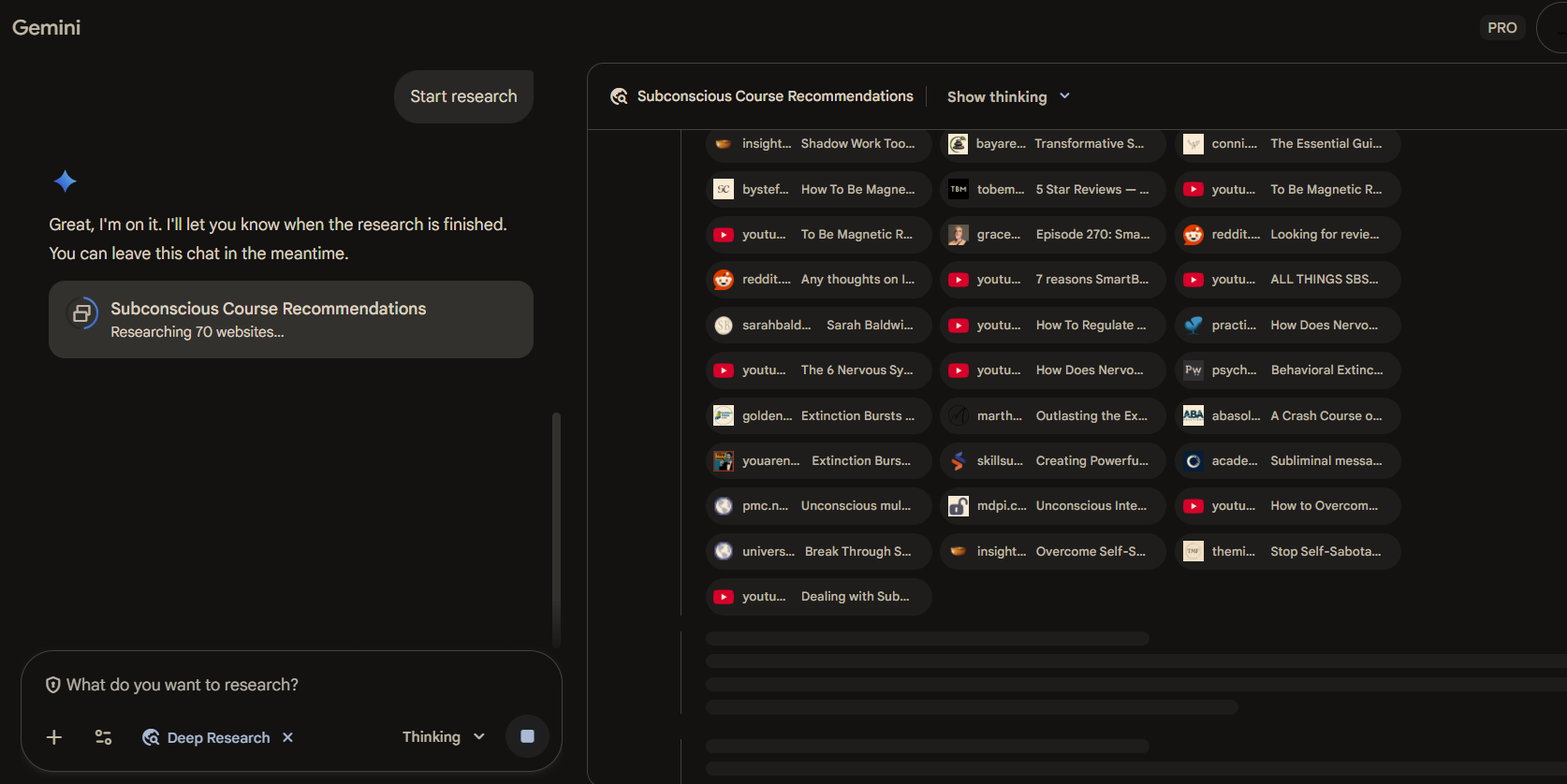
On a side note I stumbled across Gemini 3.0’s research mode

Have sent it off to fetch me recommendations on books and courses that will help understanding the subconscious mind

The book one has returned and I’m pleasantly surprised with the results. Updated my reading list as a result

Just waiting to see what the course one says…

1 Like

Courses:

Summary

The Architecture of Belief: A Comprehensive Evaluation of Subconscious Reprogramming and Reconciliation Curricula

Executive Summary

The contemporary landscape of personal development has shifted decisively from conscious-level cognitive strategies toward deep-tier subconscious reprogramming. This transition is driven by a growing recognition that willpower alone—a function of the prefrontal cortex—is often insufficient to override the entrenched neural pathways that constitute long-standing beliefs and behaviors. The user’s inquiry specifically targets the intersection of subliminal programming, belief rewiring, and the critical, often destabilizing phase of reconciliation.

Reconciliation, in this context, refers to the physiological and psychological resistance that arises when a new belief structure conflicts with an existing homeostatic baseline. Behavioral psychology identifies this as an “extinction burst,” while somatic therapies frame it as nervous system dysregulation. A central finding of this report is that while many courses excel at the induction of new beliefs (through hypnosis, binaural beats, or affirmation), a significant minority fail to provide adequate frameworks for managing the integration of those beliefs. This gap often leads to user attrition, re-traumatization, or the “rubber band effect,” where the subject snaps back to the original state with increased rigidity.

This report evaluates the efficacy, scientific validity, and reconciliation support structures of twenty distinct online programs. The analysis categorizes these educational products into three tiers: Foundational Comprehensive Systems, Specialized Modalities, and Technical/Esoteric Frameworks. The evaluation prioritizes courses that do not merely offer “magic bullet” solutions but instead provide robust architectural support for the nervous system during the reprogramming process.

The investigation concludes that the most effective approach for a user concerned with reconciliation is a hybrid model: utilizing The Personal Development School (Thais Gibson) for cognitive and attachment-based restructuring, supported by somatic regulation protocols from SmartBody SmartMind (Irene Lyon) or You Make Sense (Sarah Baldwin). This combination addresses both the “software” (beliefs) and the “hardware” (nervous system), ensuring that the rewiring process is sustainable.

Part I: The Neurobiological and Psychological Foundations of Reprogramming

To critically evaluate the efficacy of online courses, one must first establish the biological and psychological mechanisms they purport to leverage. The market is saturated with varying terminologies—from “quantum jumping” to “neural pruning”—but effective courses share a common grounding in established principles of neuroplasticity and behavioral psychology.

1.1 The Mechanics of Belief Formation: Synaptic Potentiation and Epigenetics

At a fundamental level, a “belief” is a fortified neural pathway. Through the process of Long-Term Potentiation (LTP), repeated firing of specific neuronal clusters strengthens the synaptic connections between them. This Hebbian principle—“neurons that fire together, wire together”—is the mechanism by which repeated thoughts become automatic subroutines. Conversely, Long-Term Depression (LTD) is the weakening of these synapses when they are unused.

Effective reprogramming requires the simultaneous induction of LTP for the new belief and LTD for the old. Courses like The Silva Ultramind System and Dr. Joe Dispenza’s Progressive Course leverage neuroplasticity by inducing altered states of consciousness (Alpha and Theta brainwaves).1 In these states, the critical factor—the conscious gatekeeper between the external environment and the subconscious—is relaxed, allowing for more direct manipulation of synaptic weights.

Furthermore, the work of Dr. Bruce Lipton, featured in his Biology of Belief course, introduces the concept of epigenetics to this framework. Lipton posits that beliefs act as environmental signals that trigger gene expression. The cell membrane, functioning as a “liquid crystal semiconductor,” receives signals from the blood (peptides/hormones) which are released based on the brain’s perception of reality.3 Therefore, changing a subconscious belief is not merely a psychological exercise but a biological imperative that alters the body’s chemical composition. Courses that fail to address this “body-mind” loop often yield poor results because they treat the subconscious as purely mental, ignoring the chemical addiction to specific emotional states (e.g., cortisol addiction in chronic anxiety) described by Dispenza.5

1.2 The Phenomenon of Reconciliation: The “Extinction Burst”

The user’s query highlights “reconciliation,” a sophisticated concept often missing from entry-level self-help materials. When a established program is challenged, the system does not passively accept the new data. Instead, it mounts a defense.

In behavioral psychology, this is known as an extinction burst. When a reinforced behavior (or thought pattern) is no longer rewarded or is actively blocked, the immediate result is not cessation, but a temporary, often dramatic increase in the frequency and intensity of the behavior.6 For a student of subliminal programming, this manifests as:

  • Cognitive Dissonance: Extreme mental fog or confusion.
  • Emotional Purging: Sudden onset of anger, grief, or anxiety without an external trigger.
  • Somatic Resistance: Physical symptoms such as exhaustion, headaches, or “flu-like” detox symptoms (often cited in energetic communities like Sapien Medicine).8

The nervous system views the “known misery” of the old belief as safer than the “unknown potential” of the new belief. This is the Homeostatic Impulse. Effective courses must provide a “Reconciliation Architecture”—tools to widen the “window of tolerance” so the user can endure the extinction burst without retreating.9

1.3 The Role of Attachment and Safety

A critical insight from The Personal Development School is that many subconscious beliefs are actually attachment strategies developed in childhood to ensure survival.10 A belief like “I must be perfect to be loved” is a safety mechanism. If a course attempts to overwrite this with “I am enough as I am” without addressing the underlying safety requirement, the subconscious will reject the new program as dangerous. This is why “brute force” affirmations often fail.

The most sophisticated courses (Tier 1 in this report) operate on the principle that safety must precede reprogramming.

Part II: Tier 1 - Foundational Comprehensive Systems

These courses represent the “Gold Standard” for comprehensive subconscious work. They provide end-to-end frameworks: theoretical education, practical techniques for induction, and—crucially—support mechanisms for reconciliation.

2.1 The Personal Development School (PDS)

Instructor: Thais Gibson

Format: All-Access Membership (Monthly/Lifetime)

Primary Mechanism: Integrated Attachment Theory (IAT) & Cognitive Autosuggestion

Course Architecture & Curriculum:

The Personal Development School offers an expansive library of over 55 courses, creating a veritable university for the subconscious. Thais Gibson’s methodology is unique in that it diagnoses the source of the negative programming through the lens of Attachment Theory (Anxious, Dismissive Avoidant, Fearful Avoidant, Secure).10

The curriculum is structured into “Roadmaps” for each attachment style. Key courses relevant to the user’s query include:

  • Emotional Mastery & Belief Reprogramming: This is the core technical course. It teaches the specific 21-day “Autosuggestion” tool designed to leverage neuroplasticity. It focuses on identifying “core wounds” (e.g., “I am defective,” “I am trapped”) and systematically dismantling the evidence supporting them.11
  • Subconscious Reprogramming: A dedicated module on the mechanics of the mind, explicitly covering why willpower fails and how to bypass the critical faculty.
  • Break Through Self-Sabotage: Directly addresses the reconciliation phase by reframing sabotage as “subconscious needs unmet.” It helps users negotiate with their resistance rather than fighting it.11

Reconciliation Support (Score: 10/10):

PDS excels here. Gibson teaches that “negative” emotions are essentially feedback mechanisms. The courses provide scripts and “need-meeting” tools to use during an emotional spike. Furthermore, the platform offers live webinars four times a week, allowing students to ask questions like, “I’m feeling a massive resistance to this new belief, what do I do?” This live access to Thais Gibson and trained coaches provides a safety net that pre-recorded courses cannot match.10

Scientific Validity:

The approach is grounded in widely accepted psychological frameworks (CBT, Attachment Theory) and aligns with current neurobiological understanding of memory reconsolidation.

Pricing & Value:

The “All-Access Pass” model (approx. $67/month or $997-$1799 for lifetime) is high-value given the volume of content.12 The ability to switch between courses (e.g., moving from “Reprogramming” to “Boundaries”) allows for a holistic treatment of the psyche.

Critical Analysis:

While the content is superb, the sheer volume can be overwhelming. A new user might feel lost in the “Netflix-style” library without the guided roadmaps. Additionally, the approach is highly cognitive; it requires writing, thinking, and analyzing, which may be difficult for users who are in a state of severe freeze or burnout.

2.2 SmartBody SmartMind™ (SBSM)

Instructor: Irene Lyon

Format: 12-Week Intensive (Enrollment typically once/year)

Primary Mechanism: Somatic Experiencing (SE) & Feldenkrais

Course Architecture & Curriculum:

Irene Lyon’s SmartBody SmartMind is fundamentally different from PDS. It operates on the premise that the “subconscious” is synonymous with the Autonomic Nervous System (ANS). If the ANS is dysregulated (stuck in Fight/Flight/Freeze), the higher brain centers (neocortex) cannot effectively install new beliefs.14

The curriculum is delivered over 12 weeks, with a strong emphasis on “neurosensory exercises”:

  • Orienting: A foundational practice of connecting the biology to the external environment to signal safety to the brainstem.
  • Pendulation: Moving attention between areas of stress and areas of safety in the body to build capacity.
  • Titration: The principle of breaking difficult experiences into tiny, manageable chunks.14

Reconciliation Support (Score: 9.5/10):

This course is effectively a masterclass in reconciliation. The entire premise is built around managing the “survival stress” that arises when we try to change. Lyon teaches that what users call “self-sabotage” is often just a nervous system that lacks the capacity for the new energy. By building this biological capacity first, the reconciliation phase becomes manageable rather than catastrophic.15

Scientific Validity:

Heavily grounded in the work of Peter Levine (Somatic Experiencing) and Moshe Feldenkrais. It aligns with polyvagal theory and the physiology of trauma.

Pricing & Availability:

This is a premium, cohort-based program (historically priced in the $1000-$2000 range, though specific current pricing varies) and acts as an “apprenticeship” with live support calls.15 The limited enrollment window is a drawback for users needing immediate help.

Critical Analysis:

SBSM is slow. It is not a “manifesting” course. Users looking for quick belief flips may find the pace frustrating. It requires a commitment to “boring” biological drills before seeing psychological shifts. However, for those with trauma history, this slowness is the exact medicine required.

2.3 Rapid Transformational Hypnotherapy for Abundance

Instructor: Marisa Peer (Mindvalley)

Format: 35-Day Quest

Primary Mechanism: Rapid Transformational Therapy (RTT) - Hypnosis + Regression

Course Architecture & Curriculum:

Marisa Peer’s course on the Mindvalley platform offers a more aggressive, targeted approach. RTT combines hypnotherapy, NLP, and CBT. The 35-day structure is designed to mimic a therapeutic intervention.17

Key components include:

  • Regression: Guiding the user back to the specific childhood scenes where limiting beliefs (e.g., “Money is bad”) were formed.
  • Command Therapy: Using authoritative, direct commands to the subconscious during the Theta state.
  • Wealth Wiring: Specific audio tracks designed for passive listening (subliminal programming) to reinforce the daily lessons.18

Reconciliation Support (Score: 8/10):

Peer introduces the “Role, Function, Purpose” technique. Before removing a belief, the user interrogates it: “What is your role? To protect me from rejection.” This acknowledgment reduces the friction of removal. However, the “rapid” nature of the course can sometimes trigger intense emotional purges that the pre-recorded format is ill-equipped to soothe compared to the live support of PDS or SBSM.

Scientific Validity:

While hypnosis is a validated clinical tool, RTT’s specific claims of “instant” transformation are sometimes viewed with skepticism in the broader clinical community. The Mindvalley platform itself uses aggressive marketing that can detract from the perceived clinical validity.19

Pricing & Value:

Available via Mindvalley’s subscription model ($499/year), which grants access to this and other courses (like Silva Ultramind), offering high ROI for voracious learners.20

2.4 The Silva Ultramind System

Instructor: Vishen Lakhiani (Adapting José Silva)

Format: 28-Day Quest (Mindvalley)

Primary Mechanism: Alpha/Theta Brainwave Training & Visualization

Course Architecture & Curriculum:

Based on the Silva Method developed in the 1960s, this course is a manual for the “control panel” of the mind. It is less about psychological excavation (like PDS) and more about functional programming.2

Core Techniques:

  • The Mental Screen: A visualization workspace created in the mind’s eye.
  • The 3-Scenes Technique: A classic reconciliation tool where the user visualizes the problem, takes an action to solve it, and then visualizes the solution. This creates a bridge for the brain to cross.21
  • Centering: The ability to enter the Alpha state at will (eyes open or closed).

Reconciliation Support (Score: 7.5/10):

The course assumes a relatively healthy psyche. It focuses on imposing new reality rather than healing the old. While the Alpha state naturally reduces stress, the course lacks specific protocols for handling deep trauma or “extinction bursts” if they arise.

Scientific Validity:

Biofeedback research confirms the existence and utility of Alpha/Theta states for learning and relaxation. The more esoteric claims (ESP, remote influencing) included in the course are less scientifically substantiated but integral to the Silva tradition.

2.5 Dr. Joe Dispenza’s Progressive & Intensive Online Course

Instructor: Dr. Joe Dispenza

Format: Streaming Video Lectures & Meditations

Primary Mechanism: Quantum Model & Meditation-Induced Transcenence

Course Architecture & Curriculum:

Dispenza’s work is a cultural phenomenon that bridges the gap between science and mysticism. His curriculum is dense, often requiring hours of study to grasp the theoretical “Why” before practicing the “How.”

  • The Progressive Course: Focuses on the “Formula.” It teaches how to move from “Particle to Wave,” essentially shifting focus from the material world (body, environment, time) to the quantum field (energy, possibility).
  • Reconditioning the Body: Dispenza argues that the body is the subconscious mind because it has memorized emotions. Reprogramming requires emotional rehearsal of the future.5

Reconciliation Support (Score: 8.5/10):

Dispenza reframes reconciliation as “crossing the river of change.” He explicitly warns students that their bodies will crave the old chemical states (anger, victimhood) and provides meditative techniques to “tame the animal” (the body) back into submission.22

Pricing & Value:

Courses are sold individually (approx. $349 for the Progressive bundle) or as part of retreat packages.23

Critical Analysis:

The content is polarizing. For some, the synthesis of quantum physics and neuroscience is a revelation; for others, it borders on pseudoscience.24 However, the meditative techniques are undeniably potent for inducing trance states conducive to programming.

Part III: Tier 2 - Specialized Modalities for Reconciliation & Shadow Work

While Tier 1 courses provide comprehensive systems, Tier 2 offers specialized tools that can be integrated to handle specific aspects of the reconciliation process, particularly Shadow Work and Nervous System Regulation.

3.1 The Pathway (To Be Magnetic)

Instructor: Lacy Phillips

Focus: Neural Manifestation & Shadow Work

Analysis:

Lacy Phillips has modernized Jungian psychology for the “wellness” generation. Her premise is that you do not manifest what you want, you manifest what you are (your subconscious beliefs).

  • The “Deep Imaginings” (DIs): These are self-hypnosis tracks specifically designed to unblock subconscious loops.
  • Shadow Workshops: This is the platform’s “killer app” for reconciliation. It guides users to find the parts of themselves they have rejected (e.g., “I am greedy,” “I am needy”) and integrate them. By owning the Shadow, the resistance to the new belief dissolves.25
  • Pricing: Affordable monthly membership (approx. $30/mo) makes it a low-risk addition.26

3.2 You Make Sense

Instructor: Sarah Baldwin

Focus: Polyvagal Theory & Somatic Parts Work

Analysis:

Sarah Baldwin offers a streamlined, highly accessible alternative to Irene Lyon. Her work combines Polyvagal Theory (Deb Dana/Stephen Porges) with Internal Family Systems (IFS).

  • Reconciliation Tool: She teaches users to identify which state they are in (Dorsal Vagal Collapse vs. Sympathetic Activation) and provides specific, quick interventions to return to “Ventral Vagal” safety.
  • Relevance: When a subliminal program triggers anxiety, Baldwin’s tools act as the “fire extinguisher”.27

3.3 Encounters with the Shadow

Instructor: Dr. James Hollis (Jung Platform)

Focus: Depth Psychology

Analysis:

For the user who prefers an intellectual, academic approach to reconciliation, Dr. Hollis provides the gold standard. This is not a “how-to” guide for manifestation, but a profound exploration of why the psyche creates barriers.

  • Relevance: It helps the user understand that their “resistance” is not a mistake, but an inevitable consequence of the ego structure. This understanding can significantly reduce the shame associated with the “extinction burst”.29

Part IV: Tier 3 - Technical & Esoteric Frameworks

These courses and resources address the “mechanics” of the signal—either the audio engineering of subliminals or the manipulation of energetic fields.

4.1 Creating Powerful & Successful Subliminal Recordings

Platform: Skill Success / Udemy

Focus: Audio Engineering

Analysis:

For the user who wishes to take full control of the “programming” variable. This course teaches the technical creation of subliminal audio:

  • Silent Subliminals: Modulating audio to ultrasonic frequencies (15kHz+) which bypass the conscious hearing but stimulate the cochlea.
  • Masking: Layering affirmations under nature sounds or binaural beats.
  • Value: Writing one’s own script is often more effective than generic files because the subconscious recognizes the cadence and syntax of one’s own internal monologue.30

4.2 Limitless Manifestor (Dylan James)

Focus: Sleep Programming & Belief Remediation

Analysis:

Dylan James is a prominent figure in the “Law of Assumption” community. His content focuses on the Theta/Delta state of sleep.

  • Technique: He advocates for playing custom affirmation tracks on loop for 8 hours during sleep. The logic is that the critical faculty is dormant during sleep, allowing for friction-less programming.
  • Reconciliation: He emphasizes “stabilization”—staying neutral when the 3D reality contradicts the new belief.31

4.3 Advanced Morphic Field Creation / Usage

Context: Energetic Programming (Sapien Medicine / Morphic Fields)

Focus: Bio-energetic Fields

Analysis:

This represents the esoteric edge of the field. “Morphic Fields” (a term coined by Rupert Sheldrake) refer to informational fields that shape form and behavior. Communities surrounding creators like Sapien Medicine use audio tracks embedded with “energetic programming” rather than verbal affirmations.

  • Reconciliation Warning: Users of these fields frequently report intense physical “detox” symptoms (fatigue, emotional volatility) as the body adjusts to the new informational pattern. This requires a high degree of somatic awareness to navigate safely.8

Part V: Comparative Analysis & Strategic Recommendations

To assist the user in selecting the optimal starting point, the following table compares the top recommended courses across the critical dimensions of Pricing, Reconciliation Support, and Primary Modality.

5.1 Comparative Data Table

Course / Platform Primary Modality Reconciliation Score Pricing Model Best User Fit
Personal Development School Cognitive + Attachment 10/10 Subscription ($67/mo) or Lifetime The “Why” Seeker needing deep structural repair.
SmartBody SmartMind Somatic (Nervous System) 9.5/10 High-Ticket (Annual Enrollment) The Trauma Survivor facing physical anxiety/burnout.
Rapid Transformational Therapy Hypnosis + Regression 8/10 Subscription (Mindvalley ~$499/yr) The Action-Taker wanting fast, targeted results.
The Silva Ultramind Visualization + Alpha State 7.5/10 Subscription (Mindvalley ~$499/yr) The Technician wanting control over mental states.
The Pathway (TBM) Shadow Work + Hypnosis 9/10 Subscription (~$30/mo) The Introspective wanting affordable depth work.
Dr. Joe Dispenza Quantum Theory + Meditation 8.5/10 Per Course (~$300+) The Intellectual needing scientific validation.

5.2 The “Reconciliation Protocol”: A Strategic Integration

The user specifically asked for a list and a recommendation on where to start. Given the emphasis on “reconciliation,” the following strategic sequence is proposed to minimize the risk of the “extinction burst” derailing progress.

Phase 1: The Foundation (Weeks 1-4)

  • Primary Course: The Personal Development School (All-Access Pass).
  • Module Focus: Start with “Subconscious Reprogramming” to understand the mechanics, then immediately transition to “Emotional Mastery.”
  • Objective: Map the current belief system. Identify attachment wounds. Learn the “Autosuggestion” tool.
  • Reconciliation Strategy: Use PDS tools to identify the “stories” behind negative emotions.

Phase 2: The Stabilization (Weeks 5-8)

  • Supplementary Course: You Make Sense (Sarah Baldwin) OR SmartBody SmartMind (if enrollment is open/budget allows).
  • Objective: Learn to differentiate between a “threat” and “expansion.” Build the nervous system capacity to hold the new beliefs without freezing.
  • Action: Implement daily “orienting” and “pendulation” exercises.

Phase 3: The Programming (Week 9+)

  • Technique Layer: Silva Ultramind or Dylan James (Sleep Tapes).
  • Objective: Now that the system is safe and stable, apply the high-volume subliminal programming.
  • Action: Use sleep tapes nightly. Use active visualization (Silva) daily.

Part VI: Critical Review & Market Landscape

6.1 The Problem of Pseudoscience and Marketing

The subconscious reprogramming market sits at the intersection of clinical psychology and “New Age” spirituality. It is vital to approach this landscape with discernment.

  • Mindvalley: While offering high production value and access to top instructors like Peer and Lakhiani, the platform is frequently criticized for aggressive upselling and “guru” marketing tactics.19 Users should look past the marketing gloss to the core utility of the techniques.
  • Scientific Overreach: Figures like Dr. Joe Dispenza and Bruce Lipton are often criticized by the mainstream scientific community for extrapolating quantum physics principles into macro-psychology.24 However, users often report that the utility of the metaphors (thinking of oneself as a waveform rather than a particle) provides the necessary psychological distance to effect change, regardless of the strict physical accuracy.

6.2 The Reality of “Instant” Results

Many subliminal courses promise “overnight” rewiring. The neurobiological reality of Long-Term Potentiation suggests that while states can change instantly, traits (permanent pathways) take 21 to 66 days of repetition to stabilize. Courses that acknowledge this timeline (like PDS’s 21-day protocols or Peer’s 30-day challenges) are inherently more trustworthy than those promising instant magical shifts.

Conclusion

To rewire the subconscious is to rewrite the source code of human behavior. However, this code is protected by a sophisticated biological firewall—the nervous system’s reconciliation mechanism.

For the user seeking the most robust path through this firewall, The Personal Development School is the recommended starting point. It offers the most complete map of the territory, explaining not just how to program, but who is being programmed (the attachment system). By fortifying this cognitive work with somatic regulation tools from Irene Lyon or Sarah Baldwin, the user can navigate the inevitable turbulence of reconciliation not as a crisis, but as a necessary phase of integration.

The path to “limitless” beliefs is not found in avoiding resistance, but in building the capacity to metabolize it. The recommended curriculum provides the architectural blueprints to do exactly that.

1 Like

Books:

Summary

Cognitive Architecture and Subconscious Reconciliation: A Comprehensive Analysis of Belief Reprogramming Literature

1. Introduction: The Mechanics of the Unseen Mind

The human endeavor to alter one’s psychological infrastructure—specifically the subconscious beliefs that drive behavior, perception, and physiological response—is a field that sits at the intersection of neuroscience, cognitive psychology, and metaphysical philosophy. The objective of “rewiring” beliefs using subliminal programming, coupled with the necessity of “reconciliation,” suggests a complex dual-process requirement. First, there is the active, constructive phase of imprinting new neural pathways, often termed “rewiring.” Second, there is the deconstructive or integrative phase of resolving internal conflict, commonly referred to as “reconciliation.”

Contemporary literature on the subconscious mind can be broadly categorized into three distinct schools of thought: the Mechanistic/Scientific, which views the brain as a biological machine subject to neuroplasticity; the Practical/Methodological, which focuses on actionable techniques like autosuggestion and hypnosis; and the Integrative/Psychodynamic, which addresses the emotional barriers, self-sabotage, and trauma that resist change. This report evaluates fifteen seminal texts not merely as standalone works, but as components of a holistic protocol for cognitive restructuring.

The concept of the “subconscious” is distinct from the Freudian “unconscious,” though they overlap. In the context of belief rewiring, the subconscious is viewed not just as a repository of repressed memories, but as a programmable “servomechanism” or operating system that executes instructions given by the conscious mind.1 The central challenge in reprogramming this system is “homeostasis”—the biological imperative to maintain stability. When a new belief (e.g., “I am wealthy”) contradicts a deeply held set-point, the psyche mounts a defense. This is identified in behavioral psychology as an “extinction burst” 3 and in self-development literature as the “Upper Limit Problem”.5

This report provides an exhaustive analysis of the literature, rating books based on scientific rigor, practical application, and relevance to the specific goals of subliminal programming and reconciliation.

2. The Biological Substrate: Neuroscience and Neuroplasticity

To effectively rewire the mind, one must first understand the biological substrate in which beliefs reside. Beliefs are not merely abstract concepts; they are synaptic connections reinforced by repetition and chemical emotion. The following texts provide the “hardware” manual for the brain, explaining why change is biologically difficult but entirely possible.

2.1 The Brain That Changes Itself by Norman Doidge, M.D.

Category: Neuroscience / Hard Science

Rating: 5/5 for Scientific Validity; 2/5 for Direct Application

Norman Doidge’s seminal work moves the concept of “rewiring” from metaphor to biological fact. Before the widespread acceptance of neuroplasticity, the brain was considered immutable after childhood. Doidge presents case studies ranging from stroke victims relearning to speak to individuals overcoming obsessive-compulsive disorders, demonstrating that the brain is plastic and malleable throughout life.7

The Mechanism of Change

The core thesis rests on the Hebbian principle: “neurons that fire together, wire together.” Conversely, neurons that do not fire together weaken their connection, a process known as synaptic pruning. Doidge details how mental practice—visualization and focused thought—can result in the same physical changes in the brain as physical practice.9 This provides the physiological justification for subliminal programming: repeated input theoretically strengthens specific neural pathways while allowing unused negative pathways to atrophy.

Strengths and Weaknesses

The primary strength of this text is its ability to dispel the “woo-woo” atmosphere often surrounding subconscious work. It validates the effort required for change. However, it is descriptive rather than prescriptive. It explains how the brain changes but does not offer a step-by-step protocol for the reader to change their specific beliefs.10 It serves as the foundational text to build the user’s conviction that change is biologically possible.

2.2 Incognito: The Secret Lives of the Brain by David Eagleman

Category: Neuroscience / Cognitive Psychology

Rating: 4.5/5 for Insight; 2/5 for Application

While Doidge explains change, David Eagleman explains dominance. Incognito illustrates the sheer magnitude of neural processing that occurs below the threshold of conscious awareness. Eagleman argues that the conscious mind is merely a CEO who receives executive summaries, while the vast machinery of the brain runs the company.1

The Illusion of Control

Eagleman posits that free will is largely an illusion, or at least significantly more constrained than we believe. Our behaviors, preferences, and attractions are driven by neural subroutines encoded by genetics and experience. This insight is crucial for “reconciliation.” Eagleman’s work suggests that “self-sabotage” is simply a conflict between a conscious goal and a subconscious subroutine that has not yet been updated. Understanding this reduces shame: the user is not “broken,” merely running legacy code.

The “Team of Rivals” Framework

Eagleman introduces the concept of the brain as a “team of rivals,” where different neural networks compete for control of behavior. This aligns with the user’s experience of internal conflict. Subliminal programming creates a new “rival” faction within the neural architecture, attempting to gain dominance over the established networks.11

2.3 The Biology of Belief by Bruce Lipton, Ph.D.

Category: Epigenetics / New Biology

Rating: 4/5 for Paradigm Shift; 3/5 for Scientific Consensus

Bruce Lipton, a cell biologist, challenges the central dogma of genetics. He argues that genes do not control life; the environment (specifically, the chemical environment of the blood, controlled by the brain’s perception) controls the genes.1

The Membrane as Brain

Lipton’s central scientific claim is that the cell membrane, not the nucleus, is the “brain” of the cell. It reads signals from the environment and adjusts the cell’s biology accordingly. The mind interprets the environment and sends chemical signals (fear or love) to the cells. Therefore, beliefs modify biology. If the user perceives the world as dangerous (a subconscious belief), the cells enter protection mode, shutting down growth and immune functions.14

Critical Reception and Weaknesses

While Lipton’s work on the cell membrane is grounded in biology, his leap into quantum mysticism and the Law of Attraction draws criticism for overextending scientific findings.13 Critics argue that while epigenetics is real, the idea that one can cure cancer solely through thought is a dangerous oversimplification. However, for the user’s purpose of “belief rewiring,” Lipton provides a compelling narrative that links psychological programming to physical health, increasing motivation.

3. The Programming Manuals: Techniques of Autosuggestion

Once the biological plausibility is established, the user requires specific protocols for inputting new data. This category encompasses the “How-To” manuals of the subconscious, focusing on the mechanics of the Alpha state, visualization, and linguistic programming.

3.1 The Genie Within: Your Subconscious Mind—How It Works and How to Use It by Harry W. Carpenter

Category: Practical Instruction / Self-Help

Rating: 5/5 for Practical Application; 3/5 for Theoretical Depth

The Genie Within is widely regarded as one of the most accessible and practical books on the subject. Carpenter strips away the mysticism often found in older texts and focuses on the mechanics of the Alpha state.1

The Laws of the Subconscious

Carpenter outlines the specific “laws” that the subconscious obeys. It interprets instructions literally, does not process negatives (e.g., “I don’t want to be sick” is processed as “sick”), and cannot distinguish between a real event and a vividly imagined one.17 This is critical for the user’s subliminal work: if the programming contains negative syntax, it may backfire.

Techniques for the Alpha State

The book provides ten distinct methods for communicating with the subconscious. Carpenter emphasizes “getting the conscious mind out of the way” because the conscious mind acts as a “guardian” or filter. He teaches readers how to enter the Alpha brainwave state (light trance) where this filter is relaxed.17

  • Method 1: The Alpha State: Using relaxation to lower brainwaves.
  • Method 2: The Standard Affirmation: Present tense, positive, emotional.
  • Method 3: Visualization: “What fires together, wires together.”

Strengths and Weaknesses

The book is exhaustive in technique, explaining why affirmations often fail (when they trigger the critical faculty) and how to bypass this resistance. However, it is a synthesis of existing ideas rather than a source of novel scientific discovery.19

3.2 Psycho-Cybernetics by Maxwell Maltz

Category: Cognitive Psychology / Cybernetics

Rating: 5/5 for Foundational Theory; 3/5 for Modern Readability

Published in 1960, this is arguably the most critical text for understanding the mechanics of belief steering. Maltz, a plastic surgeon, noticed that some patients did not feel “beautiful” even after successful surgery, while others did. He concluded that they had not changed their “internal self-image”.2

The Servomechanism

Maltz defines the human brain as a goal-striving “servomechanism” (like a guided missile). It acts automatically to steer the individual toward the target set by the self-image. If the self-image is one of failure, the mechanism will “correct” any success back toward failure to maintain consistency.21 This explains the “reconciliation” struggle: the user is fighting their own guidance system.

The Theater of the Mind

Maltz introduces “mental rehearsal”—practicing actions in the imagination with such vivid detail that the nervous system cannot distinguish them from reality. This is the direct precursor to modern sports psychology. He argues against “willpower,” stating that you cannot “will” yourself to act differently than your self-image defines.23

  • Critical Insight: To change results, one must alter the target image, not the effort.
  • Critique: The writing style is dated, and references to 1960s culture may feel archaic, but the core cybernetic theory remains the backbone of modern performance psychology.24

3.3 What to Say When You Talk to Your Self by Shad Helmstetter

Category: Linguistic Programming / CBT

Rating: 4.5/5 for Actionable Steps; 3/5 for Complexity

Helmstetter focuses on the linguistic interface of the subconscious. He argues that “Self-Talk” is the program script. Most people unknowingly program failure through “Level 1” (Negative Acceptance) and “Level 2” (Recognition of need) self-talk.25

The Five Levels of Self-Talk

Helmstetter categorizes self-talk into a hierarchy of effectiveness:

  1. Level 1 (Negative Acceptance): “I can’t remember names.” (Destructive)
  2. Level 2 (Recognition): “I need to get organized.” (Creates guilt, acknowledges problem but offers no solution)
  3. Level 3 (Decision): “I no longer eat junk food.” (The start of reprogramming)
  4. Level 4 (The Better You): “I am an organized person.” (Identity shift)
  5. Level 5 (Universal Affirmation): Oneness/Spirituality.

Practical Application

Helmstetter argues that the brain retains every thought it has ever processed. Repetition is the key language. This book is highly actionable for users who struggle with visualization but are verbal thinkers. It directly addresses the “internal chatter” that constitutes belief reinforcement.27 However, the book is often criticized for being repetitive, stretching a simple concept over many pages.28

3.4 Atomic Habits by James Clear

Category: Behavioral Psychology

Rating: 5/5 for Behavioral Integration; 4/5 for Identity Theory

While primarily a habit book, Clear’s thesis is fundamentally about belief rewiring through action. He argues that “true behavior change is identity change”.29

Evidence-Based Identity

Clear suggests that habits are the “vote” one casts for the type of person one wishes to be. Instead of focusing on outcomes (“I want to lose weight”), one focuses on identity (“I am an athlete”). Subliminals provide the suggestion; habits provide the proof to the subconscious that the suggestion is valid. This bridges the gap between the “mental” work of Maltz/Dispenza and the physical reality.31

  • Reconciliation: Clear’s method helps reconciliation by using “small wins” to bypass the brain’s fear of drastic change.
  • Critique: Some critics argue it misses the deeper emotional/trauma work required for severe self-sabotage 32, making it a necessary but not sufficient part of the protocol.

4. The Metaphysical Bridge: Feeling, Faith, and Quantum Mechanics

This section covers books that combine the mechanical, the metaphysical, and the practical into comprehensive systems. These texts often rely on the premise that consciousness impacts physical reality, a view supported by Lipton but expanded here into spiritual technologies.

4.1 The Power of Your Subconscious Mind by Joseph Murphy

Category: New Thought / Metaphysical

Rating: 4.5/5 for Inspiration; 2/5 for Scientific Rigor

This is the quintessential text on the subject, merging Christian mysticism with William James’s psychology. While Maltz views the subconscious as a machine, Murphy views it as a “treasure house” or a connection to Infinite Intelligence.1

The Scientific Prayer

Murphy advocates for “scientific prayer”—essentially affirmations repeated in a state of drowsiness (the hypnagogic state) just before sleep. This bypasses the “critical factor” of the conscious mind. He posits that the subconscious is amenable to suggestion and controls all vital functions. The “Law of Life is the Law of Belief”.35

Critique and Religious Overtones

The book is heavily anecdotal and religious, often citing Bible verses as psychological allegories. This can alienate secular readers. Furthermore, the “faith healing” aspects are not supported by rigorous data in the text. However, its optimistic tone makes it a powerful starting point for those needing hope and motivation.37

4.2 Feeling is the Secret by Neville Goddard

Category: Metaphysical / Law of Assumption

Rating: 5/5 for Technique Purity; 2/5 for Accessibility

Neville Goddard focuses entirely on the state of sleep and the feeling of the wish fulfilled. He argues that the subconscious is the “female” aspect of the mind that receives the seed (idea) from the conscious “male”.36

The Gateway of Sleep

Goddard’s central thesis is that “Sleep is the natural door into the subconscious.” The feeling generated just before sleep determines the programming of the subconscious for the next day. This is the direct manual for the “subliminal” aspect of the user’s query, explaining why the programming must be done in a relaxed state (SATS - State Akin To Sleep).40

Feeling vs. Emotion

Goddard distinguishes between “emotion” (reactive) and “feeling” (knowing). The goal is to assume the feeling of the wish fulfilled—acceptance of the reality of the imagination—rather than high-energy excitement.41 The text is short, dense, and esoteric, requiring a suspension of materialist disbelief.

4.3 Breaking the Habit of Being Yourself by Dr. Joe Dispenza

Category: Quantum Mysticism / Neuro-Psychology

Rating: 4.5/5 for Protocol; 3/5 for Scientific Controversy

Dispenza is the current leading figure in merging neuroscience with meditation. His work is essential for the user’s “rewiring” goal because he addresses the emotional addiction to old beliefs.42

Emotional Addiction

Dispenza argues that personality creates personal reality. To change reality, one must change personality (how one thinks, feels, and acts). Most people live in the past because their bodies are chemically addicted to the stress hormones associated with their past traumas. The body becomes the mind, running the show.43

The Reconciliation Phase

Dispenza explains the “river of change”—the gap between the old self and the new self. During this phase, the body craves the old chemical state (fear, anger). This withdrawal symptom is the physiological explanation for the “reconciliation” or resistance phase. He offers a structured 4-week meditation protocol to overcome this.45

Critique

Dispenza is often criticized for his interpretation of quantum physics. For example, he cites studies on prayer affecting the past (retroactive intercessory prayer) which have been debunked or are highly controversial.46 His conflation of the “observer effect” in quantum mechanics with psychological observation is rejected by mainstream physicists. However, the psychological and meditative aspects of his work are widely praised for their effectiveness in breaking patterns.47

4.4 You Are the Placebo by Dr. Joe Dispenza

Category: Mind-Body Medicine

Rating: 4/5 for Healing Focus; 3/5 for Scientific Controversy

Building on Breaking the Habit, this book focuses specifically on the power of belief to alter physical health. It serves as a deeper dive into the mechanisms Lipton introduces.44

Borrowing Belief

Dispenza suggests that the “placebo effect” is simply the body healing itself through the expectation of healing. He teaches readers how to become the placebo—to use the power of the mind to effect physical change without the sugar pill. This reinforces the concept that “beliefs” are not just thoughts, but physiological instructions.50

  • Relevance: Useful for users whose limiting beliefs manifest as physical symptoms or chronic conditions.

5. The Architecture of Reconciliation: Shadow Work and Surrender

The user specifically requested “reconciliation.” This implies that there is a conflict between the new program and the old. When a new belief is introduced, the subconscious often rebels. The following books address the resistance, self-sabotage, and emotional blocks (shadows) that arise during this process.

5.1 The Big Leap by Gay Hendricks

Category: Psychology / Self-Sabotage

Rating: 5/5 for Concept Clarity; 4/5 for Depth

Hendricks identifies a specific phenomenon: the “Upper Limit Problem” (ULP). This is a subconscious thermostat setting for happiness, success, and love. When we exceed this setting, we subconsciously manufacture a crisis (illness, argument, financial loss) to bring us back down to the familiar zone.5

The Four Zones

Hendricks categorizes human activity into four zones:

  1. Zone of Incompetence: Things you are bad at.
  2. Zone of Competence: Things you can do, but others can do better.
  3. Zone of Excellence: Things you are highly skilled at and rewarded for (The Trap).
  4. Zone of Genius: The unique expression of your creativity.52

Reconciliation and the ULP

The ULP occurs when moving from Excellence to Genius. The subconscious interprets this expansion as unsafe. Reconciliation involves identifying the “Upper Limit” symptoms (worry, blame, sickness) and breathing through the fear rather than retreating. This book provides a clear label for self-sabotage, helping the user identify it when it happens (“Oh, I’m just upper-limiting”).53

5.2 The Mountain Is You by Brianna Wiest

Category: Emotional Intelligence / Shadow Work

Rating: 4.5/5 for Insight; 3/5 for Repetition

Wiest’s book is a modern manual on self-sabotage. She argues that self-sabotage is not hatred of the self, but a misguided attempt by the subconscious to protect the self.55

Self-Sabotage as Unmet Need

Wiest posits that self-sabotage acts as a safety net. For example, procrastination is not laziness; it is a way to avoid the anxiety of potential failure. To reconcile, one must identify the need the sabotage is meeting and find a healthier way to meet it.56

Microshifts

Wiest advocates for “microshifts”—tiny increments of change—to bypass the brain’s fear response. This aligns with the “Kaizen” approach and is critical for users experiencing heavy resistance (extinction bursts). Large leaps trigger large resistance; microshifts allow the subconscious to adjust gradually.56

  • Critique: Some readers find the book repetitive and lacking in the hard scientific structures of Doidge or Dispenza, functioning more as a collection of essays than a linear manual.57

5.3 Letting Go: The Pathway of Surrender by David R. Hawkins, M.D., Ph.D.

Category: Emotional Processing / Spirituality

Rating: 5/5 for Emotional Release; 3/5 for Pseudoscience (Kinesiology)

If Dispenza is about adding new programs, Hawkins is about deleting the old emotional charge. This is the ultimate reconciliation text. Hawkins describes a mechanism of surrendering the feeling behind a belief.59

The Pressure Cooker Mechanism

Hawkins argues that thoughts are driven by the pressure of suppressed emotions. A single repressed emotion (e.g., fear) can generate thousands of fearful thoughts. Trying to change the thoughts (affirmations) without releasing the emotion is inefficient. The “Letting Go” technique involves observing the sensation of the emotion in the body without resisting it, modifying it, or labeling it, until the energy runs out.61

The Map of Consciousness

Hawkins introduces a logarithmic scale of consciousness (from Shame to Enlightenment). While the concept of emotional hierarchy is useful, his method of “calibrating” truth using muscle testing (applied kinesiology) is widely regarded as pseudoscience and lacks empirical validity.60 Readers are advised to use the emotional surrender technique while remaining skeptical of the “calibration” claims.

5.4 Existential Kink by Carolyn Elliott, Ph.D.

Category: Shadow Work / Integration

Rating: 4.5/5 for Shadow Integration; 3/5 for Accessibility

This book offers a radical approach to “reconciliation.” Elliott argues that we do not just suppress the negative; we actually enjoy it on a subconscious level. The psyche gets a “kink” or twisted pleasure from its own suffering (victimhood, poverty, chaos).62

Integrating the Shadow

“Existential Kink” involves admitting the pleasure one gets from the stuck pattern. By bringing this secret pleasure into the conscious mind and approving of it, the polarity collapses, and the pattern dissolves. This addresses the deepest form of resistance: the subconscious refusal to let go of suffering because it provides a perverse form of gratification or safety.63

  • Relevance: This is essential for users who find that affirmations and positive thinking fail to shift deep-seated patterns.

5.5 The War of Art by Steven Pressfield

Category: Creativity / Motivation

Rating: 5/5 for Motivational Framing; 2/5 for Technical Detail

While technically a book on creativity, Pressfield’s concept of “Resistance” is a perfect personification of the subconscious pushback against change.

Resistance as a Force

Pressfield treats Resistance not as a psychological defect but as an objective, universal force, like gravity. It aims to keep things as they are. “Resistance is experienced as fear; the degree of fear equates to the strength of Resistance”.64 This framework helps the user depersonalize their struggle. “I’m not lazy; I’m facing Resistance.” It is the antidote to the “victim mentality” that often accompanies failed reprogramming efforts.65

6. The Counter-Intuitive Approach: Managing Control and Anxiety

Finally, it is vital to include a perspective that warns against the obsession with rewiring. The user’s desire to “program” the mind can itself become a form of anxiety or control-freakery.

6.1 The Antidote: Happiness for People Who Can’t Stand Positive Thinking by Oliver Burkeman

Category: Philosophy / Stoicism

Rating: 5/5 for Mental Health; 3/5 for “Rewiring”

Burkeman argues that the constant effort to be “positive” and “rewire” the mind can backfire, creating a “hyper-reflection” where we monitor ourselves for happiness, thereby killing it.67

The Backwards Law

Drawing on Alan Watts and Stoicism, Burkeman explains the “Backwards Law”: The desire for a positive experience is itself a negative experience. Accepting the negative experience is a positive experience. He advocates for “Negative Capability”—the ability to exist in uncertainty and doubt without reaching for facts or reason.68

The Stoic Pause

Burkeman reintroduces Stoic practices like the “Premeditation of Evils” (visualizing the worst-case scenario). Paradoxically, this reduces anxiety more effectively than positive affirmations because it removes the fear of the unknown. For the user, this book serves as a “safety valve” to prevent the reprogramming process from becoming a source of stress.70

7. Comparative Analysis and Synthesis

To assist the user in navigating this library, the following tables compare the texts based on their primary utility in the reprogramming protocol.

7.1 Table 1: The Spectrum of Reprogramming Approaches

Book Title Primary Mechanism Best For… Key Weakness
The Genie Within Alpha State / Hypnosis Learning specific “how-to” techniques. Lacks theoretical depth.
Psycho-Cybernetics Visualization / Servomechanism Changing self-image & performance. Dated language.
What to Say When You Talk to Your Self Linguistic Repetition Verbal thinkers / Constant chatter. Repetitive content.
Feeling is the Secret Hypnagogic Feeling Subliminal / Sleep programming. Esoteric / Abstract.
Atomic Habits Behavioral Reinforcement Locking in beliefs with action. Misses deep trauma work.

7.2 Table 2: The Spectrum of Reconciliation (Resistance)

Book Title Concept of Resistance Reconciliation Strategy Scientific Rigor
The Big Leap Upper Limit Problem Expand tolerance for joy. Low (Anecdotal)
The Mountain Is You Unmet Need / Safety Microshifts / Meeting the need. Medium
Letting Go Suppressed Emotion Surrender / Observation. Low (Pseudoscience mix)
Breaking the Habit… Chemical Addiction Meditation / Emotional Rehearsal. Medium (Quantum debate)
Existential Kink Secret Pleasure Owning / Approving the shadow. Low (Psychodynamic)
The Antidote Backwards Law Stoic Acceptance / Negative Capability. High (Philosophical)

8. Strategic Curriculum: The Reading Order

To maximize the efficacy of the “rewiring” process, the user is advised not to read these books randomly. The following sequence is designed to build understanding, then technique, then integration.

Phase 1: The Operator’s Manual (Technique)

Goal: Master the mechanics of inputting subliminal commands.

  1. START WITH: The Genie Within (Harry Carpenter).
  • Rationale: It is the most direct instruction manual. It explains the Alpha state (where subliminals work) and how to bypass the critical factor. It is less dogmatic than Murphy and more accessible than Dispenza.
  1. Psycho-Cybernetics (Maxwell Maltz).
  • Rationale: Defines the “Self-Image.” This provides the theoretical framework for what the user is trying to rewire. It introduces the “Theater of the Mind.”
  1. Feeling is the Secret (Neville Goddard).
  • Rationale: A short, powerful masterclass on the emotional component. Essential for adding “fuel” to the subliminal “engine” and utilizing the sleep state.

Phase 2: The Deep Rewiring (The Heavy Lifting)

Goal: Address the biological and chemical addiction to old beliefs.

  1. Breaking the Habit of Being Yourself (Joe Dispenza).
  • Rationale: Moves the user from “positive thinking” to “personality change.” Explains the biological resistance (chemical addiction) they will feel.
  1. The Biology of Belief (Bruce Lipton).
  • Rationale: Raises the stakes. Shows that this work is about physical health and genetic expression, increasing motivation.
  1. What to Say When You Talk to Your Self (Shad Helmstetter).
  • Rationale: Cleans up the conscious linguistic chatter that might be sabotaging the subliminal work during the day.

Phase 3: Reconciliation and Integration (The Safety Net)

Goal: Manage the inevitable resistance and extinction bursts.

  1. The Big Leap (Gay Hendricks).
  • Rationale: Identifies the “Upper Limit Problem.” When the rewiring starts working, the user will self-sabotage. This book explains why.
  1. Letting Go (David R. Hawkins).
  • Rationale: The primary tool for clearing the emotional debris that surfaces during the rewiring process.
  1. The Mountain Is You (Brianna Wiest).
  • Rationale: Provides compassionate insight into why the user might be “blocking” their own success (unmet needs).
  1. Existential Kink (Carolyn Elliott).
  • Rationale: Advanced shadow work for patterns that refuse to shift.

Phase 4: The Scientific Foundation (Validation)

Goal: Reinforce the logical mind that this is real, not magic.

  1. The Brain That Changes Itself (Norman Doidge).
  • Rationale: Hard science proof of neuroplasticity.
  1. Incognito (David Eagleman).
  • Rationale: Understanding the dominance of the subconscious machinery.

Phase 5: Maintenance and Philosophy

Goal: Sustainable living.

  1. Atomic Habits (James Clear).
  • Rationale: To lock in the changes with behavior.
  1. The War of Art (Steven Pressfield).
  • Rationale: To fight daily resistance and maintain momentum.
  1. The Antidote (Oliver Burkeman).
  • Rationale: To ensure the pursuit of self-improvement doesn’t become a source of misery.

9. Conclusion

The literature suggests that “rewiring” is not a singular event but a continuous negotiation between the conscious desire for change and the subconscious drive for safety (homeostasis). The most effective protocol involves a synthesis of these schools: using Carpenter’s and Goddard’s techniques to enter the plastic Alpha/Theta state; using Dispenza’s and Maltz’s methods to emotionally rehearse the new reality; and using Hawkins’ and Hendricks’ frameworks to surrender the resistance that inevitably arises. By following the recommended curriculum, the user creates a complete feedback loop—Input (Programming), Processing (Rewiring), and Output (Reconciliation)—ensuring deep and lasting cognitive structural change.

1 Like